Sorting out the chaos is beautiful
March 27, 2010 at 1:08 pm | Posted in Literary Fiction | 1 Comment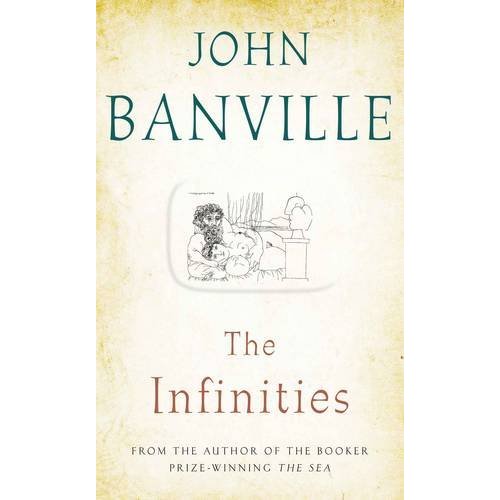 John Banville ‘The Infinities’ Picador, March 2009
Wildly ambitious ideas of physics mixed with heavyweight classical concepts of the gods, a story that takes place within a day grounded with fallible humans….this isn’t fiction a burgeoning author could take only an established literary heavyweight could tackle such subject matter. These are some of the main components of John Banville’s latest novel ‘The Infinites’.
John Banville has been long celebrated as one of Ireland’s literary masters of style. His incredible novel ‘The Book of Evidence’ was shortlisted for the Man Booker Prize in 1989. His novel ‘The Sea’ won the Booker for him in 2005 and also won him the Irish Book Awards Novel of the Year. He has been heavily influenced by James Joyce (which is often seen in his work) and by the playwright Heinrich von Kleist whose play ‘Amphitrion’ he uses as a basis for ‘The Infinites’. He says of himself that he tries to fuse prose and poetry together in his work. Another wise author said to me recently that even the best authors, especially those with a large body of work already behind them, don’t always have something original to say in each novel; does John Banville have something to say with ‘The Infinites’ and does he say it with success? Let’s find out………
In middle Ireland somewhere, in a large gloomy house the Godely family have gathered to be by the bedside of their dying father ‘Old Adam’. ‘Old Adam’s’ first wife has committed suicide, his second wife Ursula is a secret drinker whose teetering on the edge of sanity, his son ‘young Adam’ is an uninspired young man whose wife Helen is a striking beauty and his daughter Petra is an affected young woman controlled by her own nerves and has an ability for self harm. These gritty characters ground us in flawed human life but when Greek gods descend upon them to visit and play, Banville works up a whirlwind of prose with layered meanings of classics and physics. The narrator is Hermes and ‘young Adam’ becomes Zeus who ravishes his wife Helen in the opening scene, doing what ‘young Adam’ would do if he were a little more inspired.
The title ‘The Infinites’ refers to a problem that exists in the quantum field theory which found that specific types of calculations can give infinite results. The main protagonist, the dying ‘Old Adam’ is a brilliant physicist/mathematician, on a power with Einstein, who has solved this problem to infinity and while doing so proving the existence of parallel universes. The world Banville creates for ‘Old Adam’ to die in is otherworldly possibly like one of the parallel universes he has proven the existence of. Banville’s prose meditates on the idea of self identity, our place in the world and in the universe in its infinity which can leave the undiscerning reader feeling a little small. The fragility of the human is in observable in each scene in this novel in the midst of such large enigmatic forces and ideas. As with much lyrical prose writing the pace of this novel is slow, although ‘The Infinites’ has a lot to say sometimes it could be argued that it says it a little too slowly but this is counteracted with a strong narrative voice.
Maths, physics, dimensions of space and time, String Theory, M Theory, parallel universes…it seems of late some of the cutting literature out there is employing physics and prose, together in a beautiful miscellany, in an attempt to bring some order on the disorder that is the human condition and the sorting out of the chaos in such literature is beautiful.
Haiku; Gods and mortal men, to die in another world, means to live again.
Is romantic Ireland dead and gone?..not with the click of your mouse
March 8, 2010 at 8:52 pm | Posted in Great for Book Clubs, Literary Fiction | 5 CommentsTags: Book Reviews, Books, Irish Authors
 ‘Fishing in Beirut’ Steven Callaghan, Blue Press, September 2010.
Whoever said Irish writing and the Irish Publishing industry is in decline hasn’t read Fishing in Beirut. I say this for two reasons. 1. Steven Callaghan is a super brand new Irish voice in writing and 2. This novel is being published, serialized, online. Fishing in Beirut is an ambitious novel which delivers on many levels and the serialization of this story, online, is one of the most original ways I have encountered a novel. It is the story of five modern characters living in Paris. It has tangible descriptions of Paris, iconic landmarks we all know mixed in with gritty characters that reveal, through their stories, the underbelly of Parisian life that also exists. It is made up of short scenes, beautiful and sometimes poignant literary sentences that you will want to linger over. Each scene and character portrait is full of promise and you feel a culmination building the deeper you go into the novel. Callaghan’s writing is a reward in itself but is balanced with very humanly drawn out characters which makes this literary debut also a compelling page turner. What I especially loved about this novel was the Hemmingway reminiscent food descriptions which often made me hungry. With a new scene released every day I have found myself eagerly logging on. Forget the e-reader or the kindle; online publishing is clearly where it’s at. If this novel is heralding in a new era in contemporary Irish literary fiction, I for one am in. Is romantic Ireland dead and gone? No way…not with the click of your mouse!
Haiku; One Irish author, Five characters in Paris, fantastic debut
….there is also Johnston….
March 4, 2010 at 8:28 pm | Posted in Great for Book Clubs, Literary Fiction | 1 CommentJennifer Johnston ‘Truth or Fiction’ Headline Review, 2009
There is Banville, Tobin, Barry, Trevor and McGahern …but there is also Johnston. Where some of these male literary heavyweights have shined in documenting Ireland of the 1940’s & 1950’s through their novels, and have received much acclaim for this, the evolved writing of Jennifer Johnston has moved through and worked with Ireland’s passing times with grace. I for one listen with close attention when she has something to say through a novel and this latest one upholds her well deserved place in Irish literary fiction. ‘Truth or Fiction’, her nineteenth novel, explores the palpable ideas of memory, age and marriage through the story of English journalist Caroline Wallace. When Caroline is despatched by her editor to interview ninety year-old Desmond Fitzmaurice, a prolific Irish writer living in Kiliney, her own life is put into context by the tumultuous relationships she discovers between Desmond, his wife and his ex-wife. He has tape recordings made over his ninety years he pushes for Caroline to listen to but all she wants to do is a standard interview for her editor and get home. Desmond’s behavior towards the women in his life makes Caroline wonder if he is selfish or senile? Are his grandiose stories truth or fiction? Are the endless glasses of whiskey he drinks brining out history or a history he wishes he had? A handful of characters, a slow burning plot and eloquent language work like a symphony together here. This novel, like her many others, will make you use your head, your heart and your intuition. Whereas many of Johnston’s contemporaries address specific ideas at a specific time in Ireland, Johnston has broached many ideas and has gone to places in her novels her contemporaries haven’t dared to over the years. It is rumored to be a thinly veiled story about Johnston’s own heavily private father the playwright Denis Johnston. How is the main character Caroline’s life put into context by the end of the novel? Well the story begins with a marriage proposal and you’ll have to treat yourself to the book to find out the answer….
Haiku; Jennifer Johnston, new story set in Ireland, whose plot travels far
Let the great world sink
February 2, 2010 at 7:43 pm | Posted in Award winners, Literary Fiction | 1 Comment Colm McCann, ‘Let the Great World Spin’, Bloomsbury 2009
I love Bloomsbury publishers. They have published some of my favourite authors and books such as the wonderful Elizabeth Gilbert, Tobias Wolff, Amy Bloom, Hunter S. Thompson, Alexander McCall Smith and Joanna Trollope. They have broken an array of new authors and have always been amazingly discerning in their fiction lists. This is the first time they have let me down! ‘Let the Great World Spin’ is a disaster. It uses Philippe Petit’s 1974 tightrope walk between the towers of the World Trade Center as its central metaphor and recounts the story of two Irish brothers living in New York in the late 1970’s. There are a plethora of other characters introduced into the story, all with huge profound life changing experiences of prostitution, war, love and death but they simply don’t work as characters. Why? I think it is because McCann tries to include too many big ideas, for example the birth of the internet, into this story. These ideas are so big they require more detail, space and dare I say even more research into them than they are given. McCann paints a picture of a mother grieving the death of her son in the Vietnam War but the descriptions could have been of any war. The descriptions of New York give no real tangible indication that it is New York in the late seventies. There are too many characters and we don’t get a real sense of any of them. It is complicated and disjointed and the metaphor of the tightrope walker has no real place in the book. It is far too ambitious and doesn’t deliver. Jennifer Johnson’s new book ‘Truth or Fiction’ is half the size of ‘Let the Great World Spin’, has only a handful of characters and is a very simple story but evokes so much more beauty and so many more ideas by saying so much less.
National Book Award Winner 2009
Haiku; Many ideas, disconnected, were Bloomsbury thinking?
Create a free website or blog at WordPress.com.
Entries and comments feeds.
 Sarah's Books